This exercise is a series of illustrations to be used for a new range of organic biscuits for children . The range is for three varieties: Raisin, Choc Chip and Ginger biscuits. They are to feature extinct animals interacting in some fun way with a biscuit to be used on the boxes. The brief is for full colour with the colour reflecting the “flavour” of the biscuit.
As it may be the adult who makes the purchase a decision can be made as to whether to appeal to both adult and child. Also a decision to apply hand drawn or “straight” typography.
It is 24th January 2021 and I am exploring this project after completion of Part Five and after receiving OCA Tutor feedback. It may be that I am only partially able to visit this exercise before the submission date for assessment of 31st January however I feel it is worth seeing how far I can work with this brief and at least develop a plan or approaching it.
Visiting a supermarket and looking at the biscuits here are three wrappers similar to the types of biscuit mentioned in the brief:-
I have been careful not to shows the brands in the photographs:-
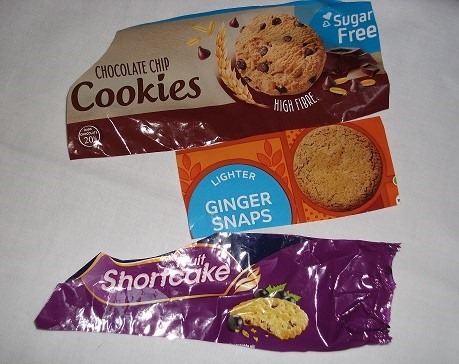
Here you can see how the colours are reflecting the ingredients:- orange/ginger, brown/chocolate chip, purple/raisins. This is helpful is identifying colour samples for the exercise.
On looking at Maja Safstrom’s book about animal from a bygone era it is interesting that dinosaurs have been intentionally left out of the book to give attention to other less known creatures that once lived on the planet. The book is illustrated in black and white. What I notice mostly as I turn the pages are the patterns – spots, stripes, fur markings, grids, feathers, leaves. May be I could investigate a “pattern” approach to the work.
As well as land animals, the book features interesting sea creatures where you can see the repeating “shell case ” of it’s scales-

Here is a giant tortoise with wonderful grid designs:-

And I just have to include the curious Dodo bird from Maja’s book too:-

I feel it is necessary to place “extinction” in some context as it is often considered a negative. This is where Lucas Riera & Jacke Tite’s book “Extinct” helps. In the introduction it explains that we tend to focus on dinosaurs, mammoths from milions of years ago, however extinction occurs all the time and can be a natural phenomenon. Some animals are simply not able to adapt to changing environments. The problems happen when species disappear much faster than normal perhaps due to hunting, overfishing, changing quality environment (pollution), habitat loss,
The book encourages conservation efforts mentioning organisations eg WWF, Project Aware, Nature Conservatory Council and also gives some tips for helping locally eg:
- Not dropping litter
- Awareness of community/garden spaces
- Planting native trees
- Using own shopping bags repeatedly instead of continuous discarding of plastic ones.
- Buy recycled/second hand products
- Support local sourced food or grown your pwn
- Be economical with products and resources – electricity, water
- Support “green” energy
- Recycle waste
This is good in being hopeful that with individual personal responsibility, a difference can be made in the collective result.
The book “Extinct” is on large pages. It lists 10 critically endangered animals that the International Union for the Conservation of Nature (UCN) are keeping track of:-
Amur Leopard, Hairy marron, Tristan Albatross, Longcomb sawfish, Mountain bongo, The Variable Cuckoo Bumblebee, Chinese pangolin, Sumatran orangutan, Orinoco crocodile, Vaquita
It also gives examples of where animals have been “saved” eg by reintroducing species to protected areas, banning the sale of certain animal products, and mentions positive achievements =in 2016 the giant panda was removed from the endangered list due to international conservation efforts.
In this book “Extinct” I notice the overall forms more as opposed to the patterning, probably because the illustrations are in colour.

However here colour and pattern is clearly seen together in The Passenger Pigeon. 1900 marked the last Passenger Pigeon:-

I think dinosaurs should have a mention. Yesterday on the news (29th January 2021) it detailed a well preserved dinosaur footprint found by a four year old girl on a beach – Bendricks Bay, Barry in the Vale of Glamorgan. Scientists believe this finding could help research how dinosaurs walked. The footprint is 220 million years old and has been preserved in rock, although it is not possible to identify the type. However similar foot prints in USA are known to have been made by the dinosaur Coclophysis.
The foot print is being taken to the National Museum Cardiff where it will be preserved and studied. It will help to establish more about the structure of the feet as the preservation is clear enough to show individual pads and claw impressions.
Personally I always feel something is lost when findings are moved from their place of origin, although appreciate it is necessary to protect them. Perhaps in the future it will be possible to maintain and study such features in situ.
I did a very quick sketch of the “claw” as I saw it on the BBC page rather then scan it:-

As a youngster I was quite cautious of the idea of dinosaurs. I find it interesting that dinosaurs are considered almost “Friendly” and fun imagery for children to enjoy nowadays . May be that is a sign of progress in presentation and education with regard to creatures of the past and the relevance to today regarding how environments can change.
The British Natural History museum is another source of fascinating specimens from all ages to explore.
I have only now and tomorrow to address this exercise further so I also need to adapt my work accordingly. I have watched Giles Deacon (a fashion designer who likes working and drawing with nature). He demonstrates how to create a repeating pattern design on Youtube.
He explains this process can be used for fabrics, wallpapers, wrapping paper, posters etc.
This seems an opportunity to try a repeated pattern process. It is not quite meeting the criteria to create thumbnails and visuals for the packaging however at least it may provide some initial response in keeping with the overall theme of extinct animals and the biscuits.
So deciding to work with the footprint I draw three biscuits and some patterning.
It is 31st January so I can only add to this work today before assessment. So I am going to enjoy some experimentation:-
According to the instructions you start drawing in the middle of the page, then make sure you do not draw over page edges:-

Next the paper is divided in two down the middle length ways and the inner edges placed outward:-

I then use this page to add more drawings/detail:-

I feel it is starting to look quite interesting. I can then continue to divide the paper and repeat the process and add some colour:-


It has turned out far more exotic than intended and would not necessary be viewed as relating to extinct animals. The work in any case certainly needs refining and there is still a blank area in the middle, however it has been interesting to explore this technique of repeated pattern for packaging.
At the moment I do not have access to a photocopier however you could multiple the above placing the sheets to the left and right of one another to further demonsttate how the pattern connects and repeats.
You could re-visit this design – Presently it is a bit weird and chaotic however by looking at elements that work, enlarging some of the patterns and omitting others within a bolder process , there would no doubt be a more pleasing result.
I am aware I have not met the brief however have I managed to respond in a short timescale to the exercise as an opportunity to experiment.
Today on the BBC website there is an article about the last surviving Mountain Hares in the Lake District. They lived in England in the last ice age and were re-introduced by landowners in the 1870’s. Currently they are being studied again to help guide further re-introduction and safe guard the present ones. This is hope in action.
References:
Safstrom. M Animals of a Bygone Era, an illustrated compendium. Ten Speed Press, New York.
Riera, L, & Tite, J, (2019), Extinct, an illustrated exploration of animals that have disappeared, Phaidon Press Limited, London.
Scheffler, A, (2018), Flip Flap Dinosaurs, NC Ltd. London
 Adelaide Art