In preparation of this exercise it is good to research the work of abstract artist of Frieda Hughes. Her book “Alternative Values” is a study of her history and childhood in a series of abstract paintings and poems.
Freda Hughes was born in London in 1960 and grew up in Devon. She wrote and painted from an early age and for many years has been a painter and children’s writer.
An account in her book explains ” Freda Hughes’s poems and paintings reflect her early years in Devon and Yorkshire, her later experiences when living in London, Australia and most recently, Wales. From childhood, writing and painting have been two driving forces behind her commitment to life. They first came together in her illustration of two of her seven published children’s books, and through her cartoons (Freda was cartoonist for the West Australian magazine when living in Australia in the early 1990’s).”
Her mother, the genius writer and poet Sylvia Plath (her father Ted Hughes/poet laureate).
I find Freda’s work inspiring, fluid, colourful and textured with lots of movement. In 2002 Freda Hughes received an award to support her work on “Forty-Five”, a summary of her life at the age and an abstract panel depicting the emotional landscape of her life. This is the beginning of a growing collaboration between her poetry and her artwork which is developed in “Alternative Values” of 40 colour plates of both her abstract and figurative work.
Here are some examples from “Alternative Values”:-
Life: demonstrates how virbrant Freda’s work is:-

Her painting is like poetry. Here in transition, you can feel the confusion and chaos in the moment of change:-

A more textured work is “Woman as window”:-

And you can certainly distinguish the owl features in “Alternative Values”:-

For the exercise I am choosing Beethoven (Symphony No.9 in D minor) to convey as abstract image.
Beethoven is an interesting character (1770 – 1827) . He is perceived as a heavy weight composer with his passionate renderings of composition and performance. There were questions about his personal manners/presentation however his powerful and complex works went above and beyond any offence he may have caused. The piano required development and flexibility to accommodate his increasing idea. He struggled with deafness and in 1814 he stopped playing in public however he continued to compose.
Beethoven composed the 9th Symphony between 1822 and 1824. It was first performed on 7th May 1824 when Beethoven had completely lost his hearing. It consists of four movements and finishes with a choral piece. The words for which are from the “Ode to Joy”, a poem by the historian and poet Friedrich Schiller written in 1785. The poem is based on freedom and equality. Beethoven sets these themes of freedom and brotherhood to music.
Linked to the tragedy of the pandemic one of the emerging discussions is equality and it seems appropriate to look at Beethoven’s 9th symphony and interpret the elements in abstract form.
Here are the words in English from the choral music:-

The choice is the second movement. It is a lively piece “molto vivace” It brings to mind the word excitement.
This is my first sketch response to the music:-

The left hand corner is selected as this includes the rapid repeating sounds, expanding boom with the supporting contrasting tones.

After listening to the music and sketching a response and selection, I pastel out a design. The blue circle represents the occasional “boom” in this second movement. It is a lively piece and the energy is symbolised in the red and yellow tones with the occasional quieter moments threading through in green. The circle also reminds of the new sun forming.

The design above could be left as the final piece however I now experiment painting over the image in acrylics and then scrapping off the surface to reveal the pastel colours beneath.

This seems to have added texture, interest and movement. There is more of sense of excitement and formation. The sun is “hatching out” . This is new life, new beginnings of happiness in community spirit.
Of note it is the 250th anniversary of Ludwig van Beethoven’s birth and I hope to watch the series of “Being Beethoven” on BBC4 telling his story in the present tense of how he would have experienced his life in the context of his own time and place.
Further information re: Beethoven (following coursework feedback): –
In the Daily Mail (17th July 2020):- an article re: 250th Anniversary of Beethoven’s birth details ” it is the music that encompasses us all, from the surging enveloping richness of the middle period, to the more spare, thoroughly modern late chamber pieces. It is music that does not belong in a court or a palace, it’s about real life, and the real world, whether you are listening in the concert hall or whistling the tunes as you walk. You do not need to be musical to understand Beethoven, to feel the majesty, the greatness, the universality : whatever you do, wherever you are, you will be stirred by his overwhelming stream of sound. Here is the scanned article:-

The article concludes: – Beethoven’s birthplace chose to mark the anniversary in an installation called “Ode to Joy” of 700 waist high brightly coloured statues of the composer were installed around the Beethoven monument in the centre of Bonn. These statues were not scowling as in the famous plaster caste, all these statues of Beethoven were smiling.
October 2020 and here is Beethoven’s statue from Daily Mail 17.10.2020 article:-

Andy Harper (a contemporary artist based in Cornwall) gives a good demonstration of painting to music on a Youtube video from Seasalt studio. His advocates a “warm-up” process of applying an ordinary marker pen practicing mark making first ie, scribbling, dashes, dots, lines. This is to see what the pen can do and how it works on the paper. Another good idea is to have all the watercolour paints potted up and brushes at the ready for quick spontaneous painting. And to have newspaper beneath your painting so you can paint over the sides filling the surface area without worrying about marking the table.
The process is abstract. There is no intention to draw anything specific. It is about becoming immersed in the sound and making marks accordingly in time to the music.
Once the marker pen drawing has been completed, Andy then works with colour although there is no set sequence of media use and the paint can be “drawn” with sponges, cloths etc. There are no rules. It more of a dance and having fun responding to the sound and interpreting it with the movement of drawing and painting.
It is a wet rainy day and what better than to be cheered by Ode to Joy and revisit this exercise:-

I feel this captures the vigour and energy of the piece – the expanding sound. And now in paint:-

The colours are Autumnal and I wonder if I am being influenced by the colours in the environment at the moment. It feels like blustery wind and swirling leaves. I like the heart which appears in the upper centre. It is so different from my earlier work in felt tip pen, although some of the circular “sounds” are still present and up sweeping marks.
The next experiment is painting over a music score:-

Then just a few colours for the quieter themes in the music, the sense of dance feels achieved here:-


Then I have a perfect storm and mix all the colours on the page ! Perhaps this reflects the power, depth and intensity of Beethoven:-

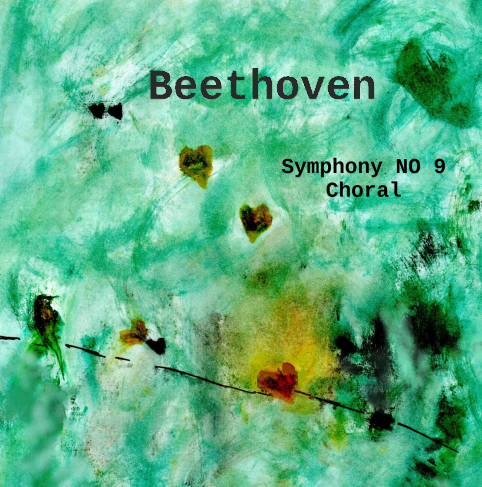
Finally in removing excess paint from the image above I press the page out and make a print on another piece of paper, smoothing it over with a piece of cloth. Although the result is abstract I develop a bird and hearts from the marks on the page and this seems in keeping with “Ode to Joy” and be suitable for the CD cover.:-

So an example of CD cover may also be the example below to convey Beethoven’s ninth symphony of freedom, joy and community spirit:-
Reference: Hughes, F, (2015) Alternative Values, Printed by Bell & Bain Ltd. Glasgow.
Sherman, R, & Seldon, P, (1997), A Guide to Classical Music, Alpha Books, New York.
Daily Mail Newspaper July 17, 2020.
 Adelaide Art