The first step is to read the extract provided:-

Then in responding to the questions :-
If this were to be made into a film, the main character could be male, middle-aged, serious, consistent. The reliable, conscientious type. Also shrewd, worldly-wise, care-worn. He might display some cynicism and disillusionment in the human condition due to the nature of his work. However his anger reveals his continued motivation and this is the hope in the situation that can still turn things round.
He would be some one usually fairly formally dressed in a suit but not overly smart. Neutral colours. It would be clean but a working suit, worn in a casual fashion, perhaps with a long overcoat. However this scene does not appear to be at the beginning of the day, so he may have loosening his tie, discarded his jacket, putting on a jumper. He appears to be in a reflective mood, contemplating the current situation he finds himself in, rather than in “action mode”.
The room is described as “void”, so it is sparsely furnished. There is a large desk (no doubt with a chair) , large uncurtained windows. I imagine a filing cabinet for papers, a standard telephone.
For visual reference photographs of 1940s London during the war are selected from google. The character is looking out over the scene, so an aerial view is included:-


Also a filing cabinet of that era sums up the thoughts the character is having about the cases he has been involved in:-

The character can be imagined to be a “loner”, solitary figure in a confidential profession:-

A word to capture the mood of this extract would be “sombre”. The character appears to be dwelling up on the past and viewing the damage of war-torn London. He is currently isolated in his thoughts and alienated in his anger so the photos above are deliberately chosen of buildings (not people) and mainly empty walk ways. I did consider the word “desolate” however this word indicates a lack of hope. But the character although angry is not despairing as the situation is temporary and the ray of the sun described as oscillating around the room gives that light in the midst of the troubles.
The next process in accordance with the OCA coursebook “is about textural and colouristic visual brainstorming and idea generation” making a mood board from the word “sombre”.
I choose grey card and find elements associated with war and prison eg barbed wire, iron doors, expansive water/marshes, empty railway stations and also the indication of espionage – black cabs, filing cabinets, suits, clocks.
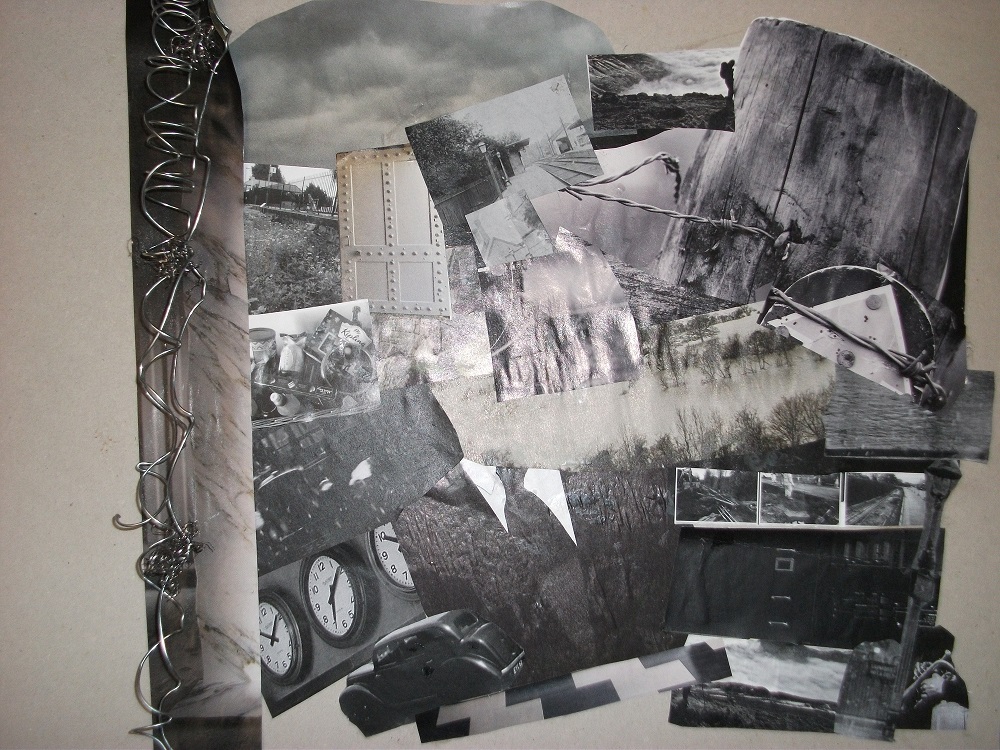
Black, grey and white tones are used. For materials and textures I find a wired spring binding (intertwined with steel sponging) echoes the barbed wire elements.
I am ready now to create the portrait of the character using the references gathered above. I would like to incorporate collage into the design.

I collage an “open office” including elements from the mood board eg barbed wire, aerial view of London, filing cabinets. The window is indicated by a partial blind. Although I do not add a large desk, this is implied by an expansive leather seat. I find a gentle sun which is described as a parallelogram of light and place it so that the shadows on the desk are correct. I am aware to be careful not to add too many additional elements to the detriment of the collage illustration theme becoming too confusing. I feel I have achieved the right tone for the extract. I leave a space in the collage to place the figure at the centre. To give emphasis to the figure I hope to make it darker than the surroundings, so I photocopy and lighten the collage.
Looking though magazines provides models to work from. It seems a good idea to present the figure as “off-duty” by a relaxed posture with their hands in their pockets looking at the through the window/blind. The figure is placed as though they have just got up from the seat of their desk. This is the initial sketch:-

Then painted in water colour:-

However the figure appears too “boyish” so it necessary to bulk it out and make it bolder using acrylics:-

This gives an improvement and establishes the figure as part of the collage. However in creating the collage perhaps insufficient space is allowed for the figure. I find in trying to fit the figure in I have skimped on some of the proportions. Although the large back & chair seat gives a sense of authority both could have been placed further to the left and the tie moved to be nearer the desk to give more space. I do another painting using the space at the top of the collage to make the figure taller and more in proportion.

Finally the image is complete. I feel this gives the impression of wistfulness as required by the content. The process of following the instructions OCA enables an achievement of results that could not initially be imaged. This is very satisfying. I may not always recall all the steps taken in this learning process however I can refer back and this will prompt a reminder.
I now read about “The daffodil affair” by Michael Innes from which the extract is taken: Inspector Appleby’s Aunt is most distressed when her horse, Daffodil goes missing from her stalls in Harrogate. Meanwhile Hudspith is hot on the trail of Lucy Rideout, an enigmatic young lady has been whisked away to an unknown isle by a mysterious gentleman. And during the blitz when a house in Bloomsbury (supposedly haunted) goes missing the policemen search for a connection. As Appleby and Hudspith trace Daffodil and Lucy, the fragments begin to come together and an extravagant project is uncovered leading them to the South American jungle.
I am now interested to read the book ……….
 Adelaide Art