A mood-board is a whole new concept as I make my very first one. In the course OCA book it explains that “moodboards are used to document visual elements interconnected by a concept or theme.”
From the list of themes given I am choosing “Wild”. Similarly to many people I like animals and nature and feel this is a theme I can communicate visually to others.
The previous exercises of creating spider diagrams and turning words into pictures involve expansion of ideas. However in creating this mood board I hope to focus on “Wild” and convey and gather material for its meaning without too diverse an approach.
I read the UCB word for Today (27th March 2020): “Focus can bring energy and power to almost anything whether spiritual, mental or physical. Sociologist Robert Lynd observed that knowledge is power only if man knows what facts to leave out. The birthing of potential breakthrough often results from sharing many good ideas. But to take ideas to the next level, you must shift from being expansive in your thinking to being selective”.
So I keep this in mind when I start to sift through material to include for my mood board.
I look through magazines, newspapers and find some wonderful photos of rocky landscapes, windswept bays, lion cubs, hedgehogs, sprinting collies and so forth.
However this is about conveying a “mood” of wildness not just a documentation of wild animals and wild places. I want to focus on just one animal. I find a photograph of a splendid looking wolf, and in the eye of the wolf you can sense it’s underlying willful nature. The turquoise of the sky in a landscape scene contains the same coloring as the wolf’s eye. A silhouette of a tree and a wolf high on a cliff remind of the noctural aspects and “darkness” in its hunting habits.
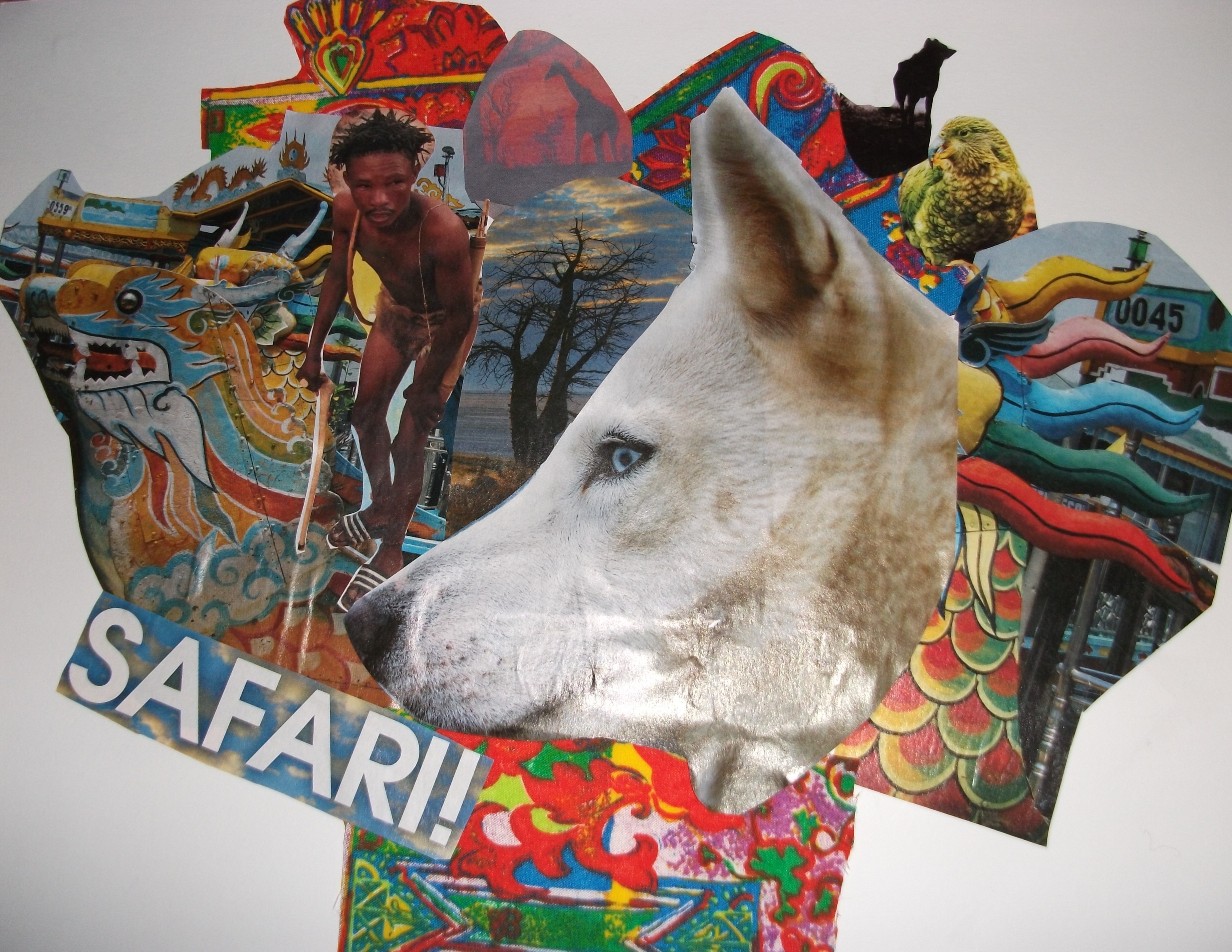
So from first glance the wolf is benign apart from perhaps a warning in the concentration of its’ eye. To indicate the wolf’s potential to be otherwise I find a colorful dragon (a photo of exotic celebrations). Here there is a display of teeth and unleashing with the wavy tails. In the mood board the dragon is split with the wolf in the middle as an opening like an explosion of “energy ” occurring in the back ground.
The figure (from an article about New Zealand) is someone who has a great experience in adapting to living outdoors. I chose this figure as the stance gives a sense of respect towards the wolf, as an indication of caution through knowledge of animals.
I find some bright material which is in keeping with the colours on the dragon and also provides a sort of emblem and crown over the head of the figure to indicate man’s authority over the wild beasts. Perhaps the red reminds of Red Riding Hood – where benign appearances may hide a different character and red for danger .
To make it reasonable to observe this “wild” mood board, I’ve chosen the word SAFARI, so it feels the wildness is controlled to a certain extent as a visitor on a SAFARI is kept at a safe distance.
Apart from the wolf the only other animals are a giraffe at night to underline the noctural aspect again and a parrot whose feathers provide some texture to the mood board.
This is about the wild nature and wary relationship between man and animal (wolf) before there is trust.
At the opposite scale would be the relationship between man and the domesticated dog.
If I were to alter this mood board I would trim round the dragon’s head to make the outline clearer and perhaps do the same for the dragon’s head.
Further Information re: Mood Boards (following coursework two completion)
A mood board helps gather ideas and inspiration . It is an aid to focus and refine thoughts, to plan and harmonize an overall design. It helps provide an idea to clients of what a finished product may look like. It ensure everyone is on the “same page” before moving from strategy to design and so helps save time and resources ( otherwise energy could be spent on an idea which does not appeal to the client ). It therefore is a check with the client’s expectations.
A mood board captures a mood, thoughts & feelings, themes and impressions. It can be electonic (digital) or physical or collage.
From Tessa Wegert “Essential Guide to Mood boards” digital mood boards are useful to share on line, upload photographs/paintings, add blocks of colour, sample fonts.
While physical mood boards can be like pin boards to pin/staple, yarn, items, collections of images, fabric swatches, coloured beads. It may be necessary to venture out for physical mood board materials.
Collage mood boards can be sourced via magazines, newspapers, catalogues, old postcards, custom sketch etc.
Ideas for a mood board according to “Shutterstuck blog” are:-
Color, patterns, textures, typography (text), key words & descriptive language, photographs, sketches & illustrations, Textiles, found objects.
Here is an example of a mood board from the internet:-

The colour swatches can be clearly seen on the above example and use of a few key descriptive words helps set the tone.
From Phoebe Avison “Making a mood Board can Improve your Life “:- mood boards can help you plan future events, such as holidays, meals, events. By collating ideas on colors, styles, images, photos, you begin to get a feel of what something will be like or what would be good. They can be simple or detailed and you may wish to make more than one for a particular theme.
Here is another example. This looks digital This appears to be about blue fabrics and textures. The images do not overlap and each photo is given equal space:-

This research is useful in understanding how mood boards are an integral part of the design process and an invaluable creative tool.
So far in the coursework I have created collage mood boards, so in future I may trial physical/digital ones.
References:
Wegert, T, (2017). Essential Guide to Mood Boards
Avison, P, (2015). Making a Mood Board Can Improve Your Life
Shutterstuck blog
 Adelaide Art